
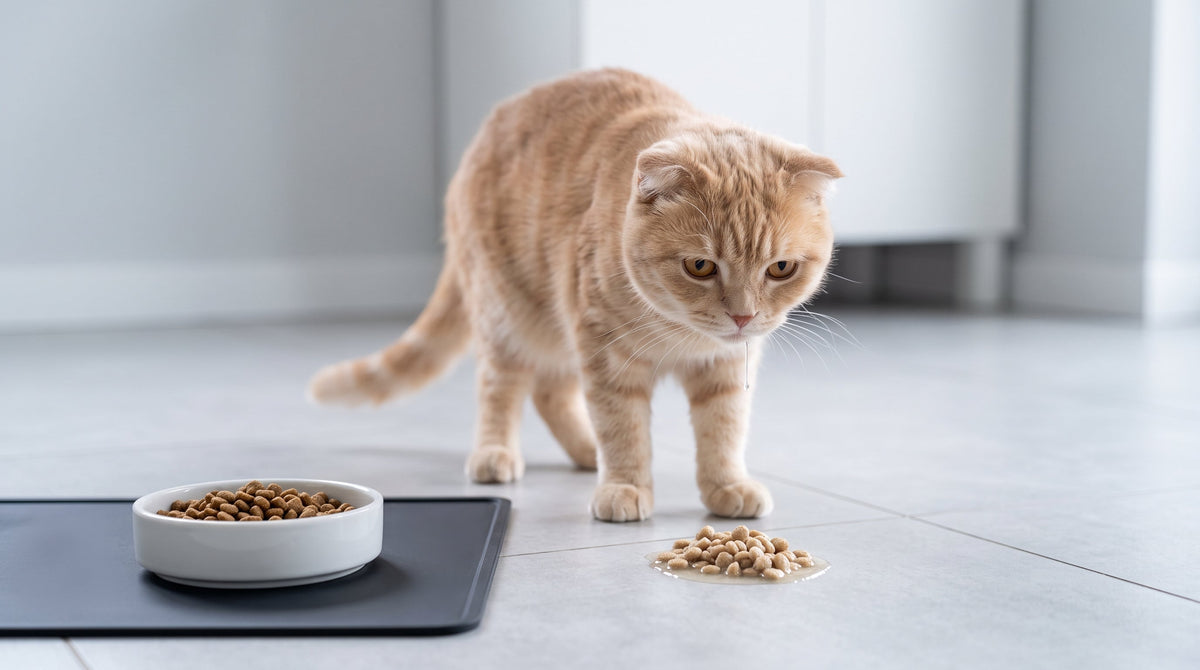

Your cat eats, then vomits. It happens again tomorrow. And the day after. You have tried three different brands with no improvement, and you are starting to wonder if something is seriously wrong. Finding the right cat food in Singapore becomes an overwhelming process when every meal seems to end in clear distress on your living room floor.
Cat vomiting after meals is one of the most common concerns Singapore cat owners search for, and one of the most misdiagnosed. Many owners assume their pet is simply fussy or prone to weak digestion, cycling through endless products in frustration. This guide walks through every cause from the most trivial to the most serious, in order, so you can identify and fix the real problem with complete confidence.
In this guide:
- First: Is This Vomiting or Regurgitation?
- What the Vomit Looks Like, and What It Usually Means
- Cause 1 — Eating Too Fast
- Cause 2 — Food Was Changed Too Fast
- Cause 3 — Food Intolerance or Sensitive Stomach
- Cause 4 — Wrong Food Type for the Cat
- Cause 5 — Medical Issue (When to See a Vet)
- Frequently Asked Questions
- Resources & References
First: Is This Vomiting or Regurgitation?
Before changing diets or buying new accessories, observe your cat carefully during their next episode. Differentiating active vomiting from passive regurgitation narrows down the root cause instantly:
- Vomiting: Involves retching, heavy abdominal contractions, and vocal distress. The material coming up is often partially digested, mixed with yellow bile or foam, and smells acidic. This signals an issue within the stomach or gastrointestinal tract.
- Regurgitation: Occurs passively and often immediately after eating. The cat simply lowers its head and casts up whole, undigested food in a tubular shape without retching. This usually indicates an oesophageal or behavioural issue, most commonly eating too quickly.
- Hairballs: A distinct third category. The cat retches repeatedly until producing a dense, cylindrical mass of ingested fur. Producing a hairball once or twice a month is normal; more frequent occurrences suggest over-grooming, skin irritation, or poor digestive motility.
What the Vomit Looks Like, and What It Usually Means
Most vomiting after eating is food-related, but not all of it. An empty stomach, a hairball or bleeding somewhere in the throat or gut each produce a distinctly different result on the floor, and reading it correctly tells you whether to adjust the diet or call the vet. The guide below is based on Purina’s veterinary guide to the types of cat vomit, with veterinary red-flag criteria from the Cornell Feline Health Center and VCA Animal Hospitals. [1]
| What you see | Most likely explanation | What to do |
|---|---|---|
| Whole, undigested food, often tube-shaped, within minutes of a meal | Regurgitation from eating too fast, or dry kibble swelling in a small stomach. Occasionally an oesophageal problem. | Work through Cause 1 and Cause 4 below. See a vet if it happens daily or your cat is losing weight. |
| Partly digested food several hours after eating | Food intolerance, a rushed food transition or slow stomach emptying. | Work through Cause 2 and Cause 3 below. |
| Yellow or yellow-green liquid or foam with no food in it | Bile brought up on an empty stomach, typically first thing in the morning after a long overnight gap. Less commonly, liver disease. | Offer a small meal late at night and split daily food into smaller sittings. See a vet if it continues for more than a day or two. |
| White foam or clear liquid | Regurgitation from the oesophagus or vomiting on an empty stomach. Sometimes the prelude to a hairball. | A one-off can be monitored. Repeated episodes, or foam with lethargy or refusal to eat, need a vet. |
| A damp, cylindrical wad of fur, sometimes with a little foam or liquid | Hairball. | Normal once every week or two. Frequent hairballs, or repeated retching that produces nothing, need a vet check. |
| Bright red streaks or fresh blood | Bleeding from the mouth, throat, oesophagus or stomach, possibly from forceful retching or a sharp swallowed object. | See a vet as soon as possible. |
| Dark brown or black material that looks like coffee grounds | Digested blood from the stomach or upper digestive tract, which may indicate ulcers. | Urgent veterinary visit. |
As a general rule, the Cornell Feline Health Center advises that cats vomiting more often than once a week, or showing lethargy, weakness, reduced appetite, blood in the vomit, increased thirst, changes in urination or simultaneous diarrhoea, should be evaluated by a veterinarian promptly. [2] VCA Animal Hospitals adds that a cat who otherwise seems well but keeps vomiting for more than one to two days should also be seen. [3] If what you are seeing matches one of the first five rows, the causes below are the place to start.
Cause 1 — Eating Too Fast
Eating too fast is the single most common cause of post-meal regurgitation in Singapore homes. This frequently occurs in multi-cat households where pets feel competitive, or in cats that receive large dry portions after a long day alone. When a cat gulps down dry kibble, the food expands rapidly upon contacting digestive juices in the stomach, triggering a sudden stretch reflex that forces the entire contents back up.
Practical Solutions:
- Switch to slow-feeders: Use a textured slow-feeder mat or a puzzle bowl to force your cat to eat individual pieces slowly.
- The stone trick: Place a large, thoroughly cleaned, smooth stone in the middle of a shallow bowl. Your cat must move around the object, slowing down their intake.
- Split meal portions: Divide your cat’s daily food allowance into 3 to 4 small sittings rather than 2 large meals.
- Elevate the feeding station: Raising the bowl 5 to 8 cm off the ground changes the gravity angle during swallowing, easing transit into the oesophagus.
Cause 2 — Food Was Changed Too Fast
Switching brands or formulas abruptly is another major cause of vomiting in local cats. When an owner suspects a current diet is causing issues, they often switch to a new brand overnight. This sudden change shocks the gut microflora, causing acute stomach upset and leading owners to mistakenly believe the new food is also toxic to their cat.
Always follow a strict 7-to-10 day transition schedule (extend to 14 days for hyper-sensitive cats):
If your cat vomits on both the old diet and a new formula introduced too quickly, evaluating which product is actually problematic becomes impossible. Slow down the timeline to isolate the truth.
Cause 3 — Food Intolerance or Sensitive Stomach
A food intolerance differs fundamentally from a true protein allergy. While an allergy involves an immune reaction, an intolerance means your cat's gastrointestinal tract simply lacks the necessary enzymes to process specific low-grade ingredients cleanly.
Common triggers found in commercial diets include corn, wheat, soy, artificial colourants, and vague "animal derivatives." Key signs of food intolerance include consistent vomiting after most meals, soft stools or diarrhoea, and gradual weight loss despite a robust appetite.
When evaluating cat food in Singapore for a cat struggling with chronic food intolerance, switching to a limited-ingredient, therapeutic-grade formula is critical.
Farmina N&D Quinoa Digestion — The Targeted Solution
Formulated specifically for cats suffering from chronic vomiting, diarrhoea, and symptoms of Inflammatory Bowel Disease (IBD), Farmina N&D Quinoa Digestion provides immediate gastrointestinal relief.
Farmina derives 92% of its protein directly from animal sources, utilising free-range lamb, wild-caught herring, and egg. Crucially, the herring is hydrolysed, broken down into microscopic molecules that digest effortlessly without triggering gut inflammation. The formula incorporates organic quinoa for low-glycaemic prebiotic fibre alongside natural botanicals like fennel and mint, which possess clinically documented properties to soothe GI spasms and reduce abdominal gas.
With a tested digestibility rating exceeding 90%, this grain-free, gluten-free recipe contains zero soy, potatoes, legumes, or artificial preservatives. It represents an essential investment for cats requiring absolute dietary stabilisation.
- Explore the range: Discover the Superpets Farmina N&D cat food collection.
- Compare options: Read our complete roundup of the Best Cat Food in Singapore for Sensitive Stomachs to compare Farmina alongside other veterinary lines.
Cause 4 — Wrong Food Type for the Cat
Sometimes the issue stems not from quality, but from texture and physical properties:
- Dry-only diets: Low moisture levels in standard dry cat food require the body to supply fluid for digestion. When dry kibble hits the stomach, it absorbs surrounding fluid, swelling substantially. In sensitive cats, this rapid expansion triggers an immediate vomit reflex.
- Ice-cold wet food: Serving open tins of wet cat food straight from the refrigerator shocks the delicate vagus nerve in the stomach. Always allow chilled food to sit at room temperature for 10 to 15 minutes, or mix in a splash of warm water before serving.
- Excessive dietary fat: High-fat gourmet wet formulas can overwhelm a sensitive pancreas and liver. Look for recipes maintaining fat content below 6% on an as-fed basis for wet food.
If your cat vomits exclusively after eating dry cat food but retains wet cat food without issue, shifting toward a wet-primary or hydrated diet can resolve the problem entirely.
Cause 5 — Medical Issue (When to See a Vet)
Dietary adjustments solve environmental and nutritional issues, but underlying systemic diseases require clinical intervention.
Seek immediate veterinary care if vomiting occurs more than 2 to 3 times in a single day, persists beyond 48 hours, contains fresh blood or dark bile, or accompanies sudden lethargy, refusal to drink, or severe weight loss.
Medical conditions that mimic food sensitivities include:
- Hyperthyroidism (common in senior cats)
- Chronic Kidney Disease (CKD)
- Inflammatory Bowel Disease (IBD)
- Intestinal parasites
- Foreign body obstruction (ingested string or plastic)
Cats dehydrate rapidly when losing fluids through vomiting. Do not delay clinical assessment if red-flag symptoms appear.
Conclusion
The vast majority of post-meal vomiting cases stem from eating too quickly, rushing food transitions, or processing poor-quality fillers, all issues you can fix directly at home.
When food intolerance is the culprit, choosing a targeted formula like Farmina N&D Quinoa Digestion delivers exceptional gut healing. You can explore the entire range within the Superpets Farmina N&D cat food collection online or in-store.
If your cat continues to vomit after four weeks on a properly transitioned, sensitive-stomach diet, consult your veterinarian for diagnostic testing. For a comprehensive comparison of veterinary diets, read our full guide on the Best Cat Food in Singapore for Sensitive Stomachs. When purchasing your cat food in Singapore, selecting specialised formulas ensures your pet stays healthy and comfortable after every meal.
Frequently Asked Questions
Is it normal for cats to vomit once a week? +
No. While occasional hairballs (once or twice a month) are normal, chronic vomiting once a week indicates underlying gut inflammation, rapid eating, or food intolerance that requires troubleshooting.
What is the best cat food for a cat that vomits frequently in Singapore? +
Farmina N&D Quinoa Digestion offers unmatched results for frequent vomiting due to its hydrolysed proteins, 90%+ digestibility rating, and anti-inflammatory botanicals. For mild sensitivity, Royal Canin Digestive Care offers a reliable alternative.
Should I withhold food after my cat vomits? +
Yes. Resting the stomach for 4 to 6 hours after a vomiting episode allows gastric inflammation to settle. Ensure fresh water remains available, then offer a tiny, bland portion (such as plain warm wet food) before resuming normal feeding schedules.
How do I know if my cat has a food intolerance vs a food allergy? +
A food intolerance causes localised digestive distress like vomiting, gurgling, and soft stools. A food allergy involves the immune system, typically manifesting as severe facial itching, hair loss, inflamed ears, and skin redness alongside GI symptoms.
Can wet food help reduce vomiting in cats? +
Yes. High-moisture wet cat food passes through the stomach far more easily than dry kibble because it does not swell after ingestion, making it significantly gentler on sensitive gastric linings.
Ready to stop post-meal vomiting for good? Superpets stocks Farmina N&D Quinoa Digestion alongside an extensive range of specialised digestive formulas. Browse online at superpets.sg for fast islandwide delivery, or visit any of our 19 physical retail stores across Singapore today.
Resources & References
- Purina — Types of Cat Vomit & What It Means ↩
- Cornell Feline Health Center — Vomiting ↩
- VCA Animal Hospitals — Vomiting in Cats ↩